November 25, 2026
Chat assistants can write an email or summarize a report in seconds. However, someone still has to read the result, open the right systems and do the next step. Agentic AI closes that gap. Instead of answering one prompt, it works toward a goal and carries out the steps itself.
In this guide, you will learn what agentic AI is, how it works and how it differs from generative AI. You will also see how we built an agent in a real project and how to judge whether it’s worth it for your business. Even if you are not a developer, you can follow along.
What is agentic AI?
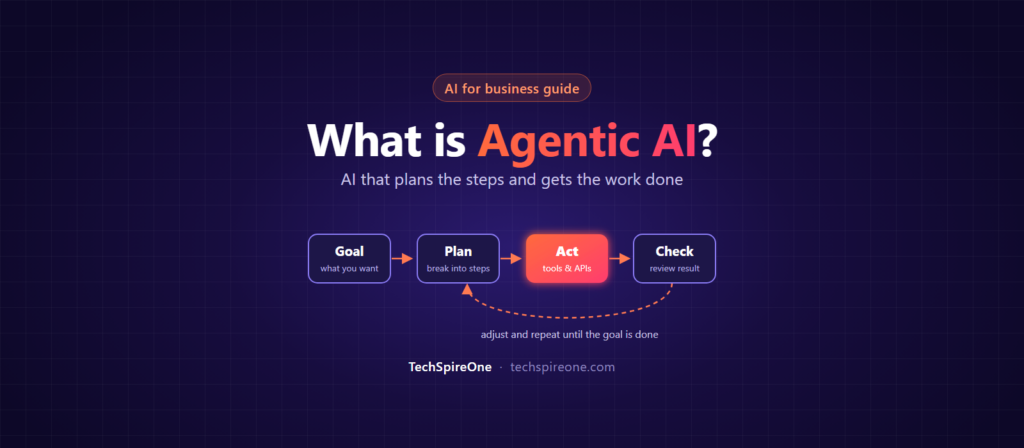
Agentic AI is artificial intelligence that works toward a goal with limited human supervision. You give it an outcome, not a single question. It then plans the steps, uses tools such as APIs and databases, checks each result and adjusts until the task is done or it needs a person.
In practice, four traits set agentic AI apart:
- Goal-driven. You ask for an outcome, such as “prepare the weekly sales report”, instead of one answer.
- Planning. It breaks the goal into steps and decides their order.
- Tool use. It calls APIs, queries databases and searches documents to get real work done.
- Feedback. It reads each result and changes course when something fails.
For example, an email agent can sort the inbox, draft replies and book meetings. Similarly, a finance agent can match invoices to payments and flag the ones that don’t match. A support agent can read a ticket, look up the order and draft a reply.
How AI agents work
Agentic AI works in a loop. The agent gathers information, reasons about the next step with a large language model, acts through a tool and learns from the result. It repeats this cycle, step by step, until it reaches the goal or hands the task to a person.
AWS breaks this loop into four stages: perceive, reason, act and learn. The language model is the reasoning engine, so it reads the goal and builds a plan. However, the model can’t touch your systems on its own. Tools do that work.
An agent usually has three building blocks around the model:
- Tools. Functions that read or change data, such as a CRM lookup or a database query. Many teams now connect tools through the Model Context Protocol, so one integration works across AI apps.
- Memory. Context the agent keeps between steps, such as earlier results or user preferences.
- Orchestration. The control logic that decides which step runs next and when to stop.
In addition, good agents know when to pause. For example, an agent can draft a refund but wait for a person to approve it. That checkpoint keeps the speed of automation without giving up control. It also leaves a record of each step, so you can see what the agent did and why.
Agentic AI vs generative AI and chatbots
Generative AI creates content when you prompt it, such as text, images or code. A chatbot uses that ability to hold a conversation. Agentic AI goes further. It uses a generative model as its reasoning engine, then plans and takes actions across systems to finish a multi-step task.
| Generative AI | Chatbot | Agentic AI | |
|---|---|---|---|
| What it does | Creates content from a prompt | Answers questions in a conversation | Completes a multi-step goal |
| Who starts each step | The user | The user | The agent, within set limits |
| Works with your systems | No, unless you paste data in | Sometimes, mostly read-only | Yes, through tools and APIs |
| Example | Draft a product description | Answer a policy question | Resolve a support ticket end to end |
Google Cloud draws a useful line between an agent and agentic AI. A single AI agent is like one tool. Agentic AI is the coordinated use of several of them to finish a larger job. In other words, the more steps and systems a task involves, the more it benefits from an agentic design.
That said, not every task needs an agent. If a single prompt gets the job done, generative AI on its own is cheaper, faster and easier to control.
What are the benefits of agentic AI?
Agentic AI pays off in four main ways.
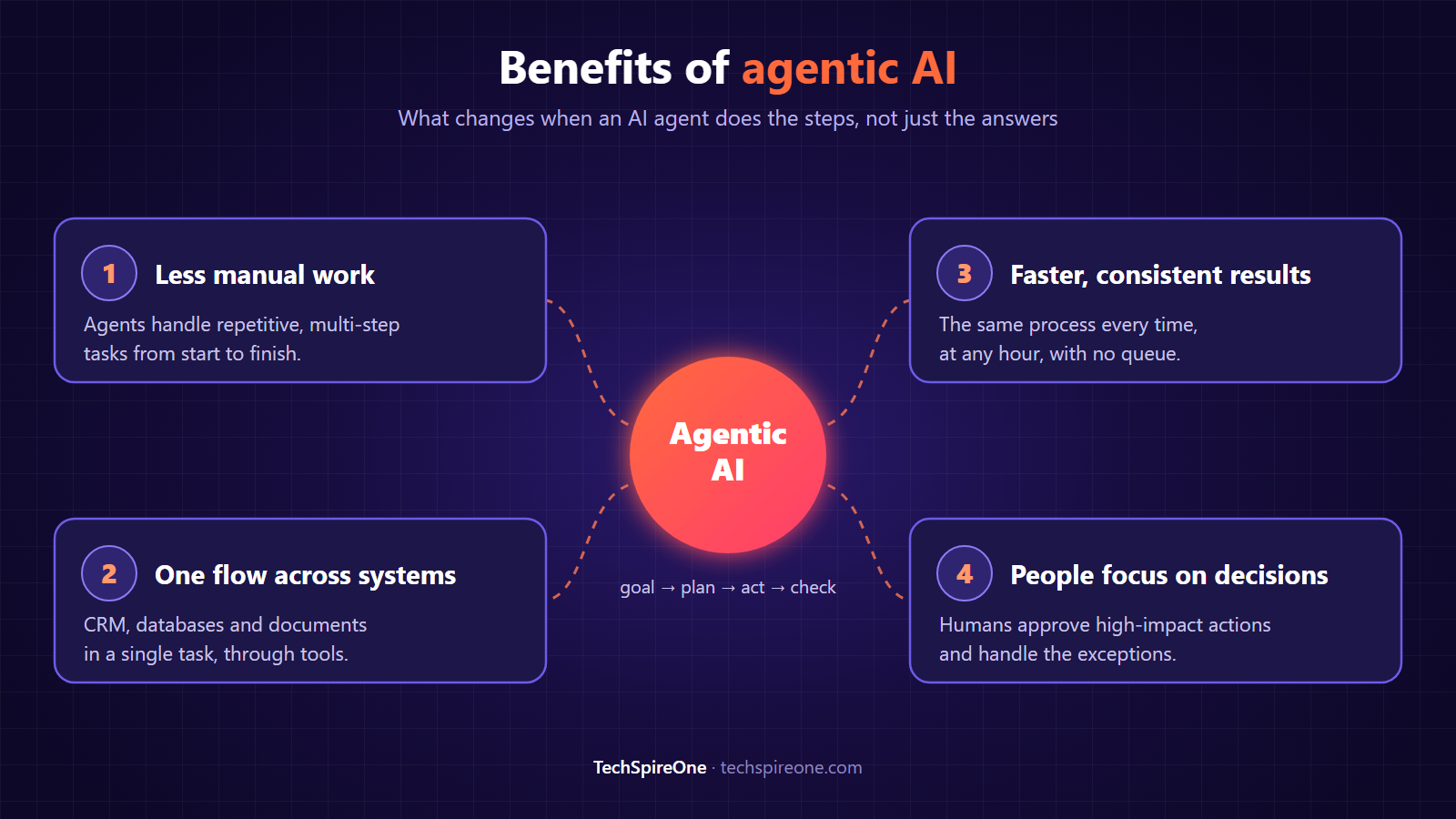
- Less manual work. An agent handles repetitive, multi-step tasks from start to finish. As a result, your team stops copying data between screens.
- One flow across systems. Through tools and APIs, an agent can read a CRM, query a database and update a document in one task. In other words, people don’t have to switch between apps to finish a job.
- Faster, consistent results. An agent follows the same process every time, at any hour. Consequently, requests don’t sit in a queue until someone is free.
- People focus on decisions. The agent prepares the work, and a person approves high-impact actions or handles exceptions. That keeps human judgment where it matters, while routine steps run on their own.
Advantages over traditional automation
Traditional automation, such as RPA bots and scripts, follows fixed rules. AI agents work from a goal instead, which gives them several advantages:
| Factor | Traditional automation | AI agents |
|---|---|---|
| Input | Structured data in fixed formats | Plain language, emails, documents and structured data |
| Rules | Every step written in advance | Plans the steps from a goal |
| Changes | Breaks when a screen or format changes | Can often handle new wording or formats |
| Exceptions | Stops and waits for a person | Tries another path, then escalates |
| Scope | One task in one system | Multi-step work across several systems |
| Setup | Quick for simple, fixed flows | Needs tools, guardrails and testing |
| Best for | High-volume, unchanging tasks | Varied tasks that need some judgment |
The biggest difference shows up when something unexpected happens. A script fails on the first unfamiliar invoice layout. An agent, on the other hand, can read it, pull out the fields and ask a person only when it’s unsure.
That doesn’t make rule-based automation obsolete. For example, a nightly data export with a fixed format is still cheaper and more predictable as a script. Agents also cost more per run, because each step calls a language model. In practice, the strongest setups combine both: scripts for fixed steps, and an agent for the parts that need reading, judgment or coordination.
Key takeaways
- Agentic AI works toward a goal, plans its own steps and uses tools, while generative AI only creates content on request.
- The best first projects are repetitive, measurable and low-risk, with a person approving high-impact actions. Start small, then expand once the agent proves its value.
- Clear tools, guardrails and logging matter as much as the model, because they decide what the agent can safely do.